TranScribe Health
  • Home
  • Read Our Stories
  • What we want
  • Submit your story
  • About
    • Support Trans Lives
    • Support Organisations

Content Warning

The Stories shared by Trans people in Ireland need to be heard, but reading them may be upsetting for Trans folks and their friends and family. Please mind yourself as you read and share this content. You can find help resources here.
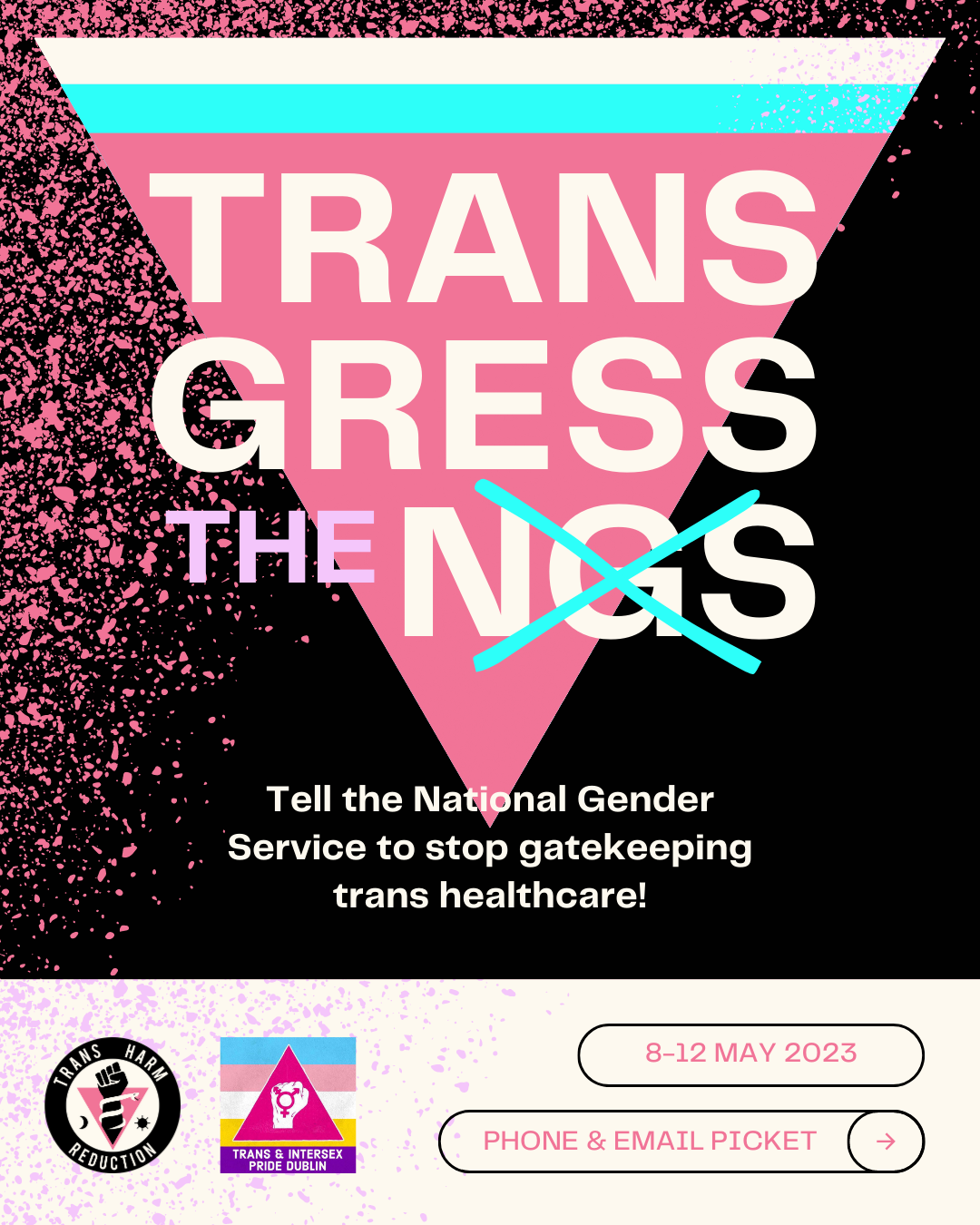
[Solidarity Post] TRANSGRESS THE NGS: tell the NGS to stop gatekeeping trans healthcare!

8/5/2023

0 Comments

 
From their action:
It’s time for us to transgress the boundaries the National Gender Service has built to prevent access to trans healthcare in Ireland. We are calling on the community to join us for a phone and email picket of the NGS to demand their public commitment to stop advising GPs against providing blood tests and prescribing HRT to trans patients.

Throughout this week (8-12 May) between 9am and 5pm, we need you to:

☎️ CALL the NGS at 01 211 5045
✉️ EMAIL the NGS at [email protected]
📃 SCRIPT linked in our bio & story

The NGS intimidates GPs into denying blood testing and prescriptions of gender-affirming hormone therapy to support their trans patients. Yet what alternative does the NGS provide? A decade-long waiting list to access a psychiatric model of care rife with invasive, damaging evaluations and inadequate treatment. We refuse to accept this.

We will not rest until we have self-determined, informed consent trans healthcare in the community through our local GPs. The NGS will not stand in our way.
Source: Instagram

NGS phone and email picket script

Please try to call first (using the script below) because this is more effective than an email. 
Call 01 211 5045 and ask to talk to any of the following:
  • Ian Schneider (chair of the clinical governance committee) 
  • Paul Moran (consultant psychiatrist), 
  • Karl Neff (clinical lead), 
  • Donal O’Shea (consultant endocrinologist) 
If they aren’t available or the receptionist won’t put you through, talk to whoever will listen.

If you are emailing, send the email to [email protected], [email protected], [email protected], [email protected] & [email protected]. Please cc [email protected]
​
Please note, if you are a patient of the NGS you may wish to use a different phone or email address to contact them than the one they have on record.

Script
​

“Hi,

I’m contacting you to support a campaign being coordinated by Trans Harm Reduction, a trans healthcare group that supports people who are self medicating in Ireland. Trans people in Ireland who wish to undergo medical transition are forced to take matters into their own hands due to the unacceptable standards of trans healthcare in this country, including the interminable waiting list for the NGS.

For those who can afford to and wish to, they have the option to privately pay for their medication, but for many, they are left to self medicate due to financial restrictions or mistrust in both the public and private medical institutions.

Trans people on HRT need to be able to access blood tests through their GPs as a basic safety check. However, we are aware that the NGS has a policy of advising GPs not to carry out these basic blood tests when trans folks in Ireland either self medicate or medicate through private health services. This situation is totally unacceptable. 

Trans people also often ask their GPs to prescribe HRT to them directly. There is no restriction on Irish GPs to do this and it would enable  trans people in Ireland to shift to accessing prescription HRT medications from their local GPs, avoiding waiting periods. We are aware that the NGS also has a policy of advising GPs not to prescribe HRT. We refuse to accept this.

Providing blood tests and prescribing HRT are both entirely within the remit and capabilities of GPs. The NGS’ policy of advising GPs not to provide them is putting trans people at serious risk. 

By preventing access to basic medical care, the NGS are attempting to force trans people onto a decade-long waiting list for their harmful system. The only thing the NGS is doing is stopping trans folks from accessing alternatives to their psychiatric model of care that is rife with invasive, damaging evaluations and inadequate treatment. Trans people should be able to self medicate or seek private alternatives safely if that’s something they wish to do. The NGS must stop interfering with people’s ability to access care through their GP.

We are demanding that the NGS publicly state that it will no longer be advising GPs not to provide blood tests or HRT prescriptions. We want a statement to be made on this by May 21st or we will take further action to ensure our demands are met.

​Regards,”
Source: Trans Harm Reduction
Picture of the trans triangle with a call to action to picket the NGS and to tell the NGS to stop gatekeeping trans healthcare
0 Comments

I had a better experience with the NGS nearly a decade ago than today

8/5/2023

0 Comments

 
Picture
I was first referred to what is now the National Gender Service in 2014, at the age of 14/15. At that time the service would accept 16/17 year old patients, and would allow 14/15 year olds onto the list. In this time before in-house assessments, I had to seek assessments. I received one from a private provider, who because of his level of respect and consideration for the trans community, rapidly became disliked by the NGS. He was seen as too willing to refer patients to the NGS, and as such even though he had provided a thorough assessment, I was advised by other trans people to seek a second, public assessment. I was assessed by CAMHS, by a clinician who was clearly inexperienced in working with transgender patients, and who in his formal assessment document described me as ‘androgynous dressing, overweight, and female-appearing’. He also used my deadname throughout despite my name being legally changed by this time. He asked me intrusive questions about my relationship at the time with a girl in my school year, and about my sexual orientation. He asked questions that reasserted binary gender roles, and showed that I was only going to be seen as legitimately trans in his eyes if I was traditionally masculine enough. 

I received my first appointment a few days before my 16th birthday. Upon my first appointment at the NGS, I was talked through by staff as though I wasn’t there. My parents were both present - although it is worth noting that 16 year olds in Ireland are legally able to make their own medical decisions, and while I was just short of my 16th birthday, they continued to require my parent’s presence until I turned 18. The endocrinologist played at being a psychologist, retracing the steps of the assessment I’d received in CAMHS, before leaving me and my parents to wait for hours for the consultant to see us. 
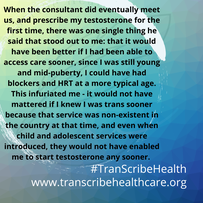
Blue background with text overlaid that says; When the consultant did eventually meet us, and prescribe my testosterone for the first time, there was one single thing he said that stood out to me: that it would have been better if I had been able to access care sooner, since I was still young and mid-puberty, I could have had blockers and HRT at a more typical age. This infuriated me - it would not have mattered if I knew I was trans sooner because that service was non-existent in the country at that time, and even when child and adolescent services were introduced, they would not have enabled me to start T any sooner.
When the consultant did eventually meet us, and prescribe my testosterone for the first time, there was one single thing he said that stood out to me: that it would have been better if I had been able to access care sooner, since I was still young and mid-puberty, I could have had blockers and HRT at a more typical age. This infuriated me - it would not have mattered if I knew I was trans sooner because that service was non-existent in the country at that time, and even when child and adolescent services were introduced, they would not have enabled me to start testosterone any sooner. 

​Over the intervening years, I’ve experienced several issues with the NGS, which have only worsened as their system focuses more on gatekeeping and controlling the community. When I sought referral for top surgery, I was pressured into taking a consultation with a surgeon I did not want to attend and had heard very negative reviews of. I ultimately did not take this consultation, but it was a barrier put in front of my being referred for surgery. Around this time the NGS started to do their initial in-house assessments, but I did not require one for surgery. After top surgery, when discussing if I wished to be referred for bottom surgery at that time, I was told that I was right not to seek a referral at present because the results were ‘unsatisfactory’ and ‘poor’ - a judgment on the bodies of other trans men. When seeking a referral for a hysterectomy, I was told I must do a pre-surgical assessment with them in order to be referred. I argued against this - I had been assessed twice already to confirm my ‘diagnosis’, I had been out, socially, legally and medically transitioning for years, and ultimately there was nothing the assessment in the NGS could explore better than a conversation with the surgery providers in the NMH. I was refused any alternative to their assessment. I have also been on the receiving end of threats around missed appointments, reschedules or cancellations. 
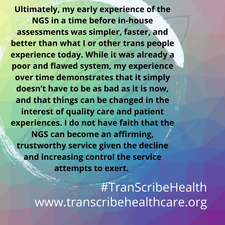
Colourful background with text that overlays the quote; Ultimately, my early experience of the NGS in a time before in-house assessments was simpler, faster, and better than what I or other trans people experience today. While it was already a poor and flawed system, my experience over time demonstrates that it simply doesn’t have to be as bad as it is now, and that things can be changed in the interest of quality care and patient experiences. I do not have faith that the NGS can become an affirming, trustworthy service given the decline and increasing control the service attempts to exert.
Ultimately, my early experience of the NGS in a time before in-house assessments was simpler, faster, and better than what I or other trans people experience today. While it was already a poor and flawed system, my experience over time demonstrates that it simply doesn’t have to be as bad as it is now, and that things can be changed in the interest of quality care and patient experiences. I do not have faith that the NGS can become an affirming, trustworthy service given the decline and increasing control the service attempts to exert. 

0 Comments

I've found self medicating to be an empowering alternative to the NGS and private trans healthcare providers

2/3/2023

0 Comments

 
I came out as trans around 5 years ago, at which point I felt very isolated and uncertain about medical options for transitioning. I was aware of the situation with the NGS including endless wait times and the horrifying stories of interrogation by hostile psychiatrists. I wanted absolutely nothing to do with that system because I didn’t think my mental health would withstand it. I also wasn’t in a position to pay for private treatment because I was unemployed and the fees for Gender GP or one of the other private healthcare providers were out of my reach.  
​
Fortunately, I managed to get in touch with other trans people who were able to provide support and get me started with self-medicating, which I’ve been happily doing ever since. As a result, I’m not suffering in silence for years on the NGS wait list or putting myself under financial strain to pay for basic medical care from a private, for-profit enterprise. People call it self-medicating, or DIY HRT, which both suggest that it’s something you do on your own, totally in isolation, but that hasn’t been my experience at all. In reality, I have received a huge amount of support and advice from peers and friends who were in the same position, and together we have accumulated a massive volume of experience and knowledge. There is also an immense wealth of knowledge available on the internet that has been put together by dedicated members of our community in places like transfemscience.org or r/transdiy. In almost all cases now when I have to interact with medical professionals I’m aware that I have vastly more knowledge than they do and I also don’t have to rely on them for my healthcare, which is a fundamentally empowering experience.
That’s not to say that I don’t have any worries because there are real risks associated with self-medicating. It’s just that there are, in my opinion, much greater risks associated with any of the alternatives, including going for years without access to HRT on the NGS wait list, the psychological trauma of undergoing interrogation by a hostile psychiatrist or the financial insecurity and stress associated with paying for private healthcare. 
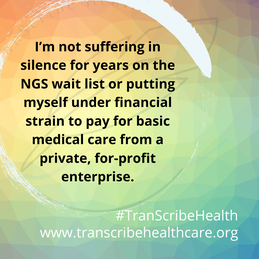
Image with colourful background, quote text reads: I’m not suffering in silence for years on the NGS wait list or putting myself under financial strain to pay for basic medical care from a private, for-profit enterprise.
In terms of the risks of self-medicating, there’s an enormous amount that even standard GPs could do to reduce these including doing blood tests to give an indication if my dosage is correct or to flag any other health issues. The first GP I went to and talked to about my situation refused to do blood tests to test my hormone levels, despite the fact that this would be a standard check they would do for any cis person who asked for it. She told me that doing blood tests would encourage me to continue with a practice they saw as risky and undesirable. ​
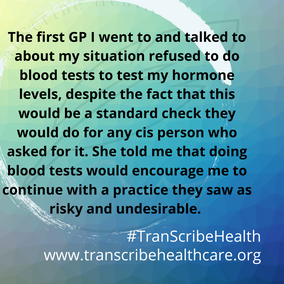
Colourful background with text overlaid that says; The first GP I went to and talked to about my situation refused to do blood tests to test my hormone levels, despite the fact that this would be a standard check they would do for any cis person who asked for it. She told me that doing blood tests would encourage me to continue with a practice they saw as risky and undesirable.
The ridiculousness of this situation is obvious if you compare it to drug or alcohol use or any other activity that involves risks to one’s health. If I had an addiction issue and went to the doctor because I was concerned about my health, basically everyone would acknowledge it would be totally irresponsible and unethical of them to say they wouldn’t treat me because it would enable or encourage me to keep drinking or taking drugs. Likewise, if I played a sport they thought was risky and injured myself, it would again be obviously ridiculous for them to say they wouldn’t treat me because it would allow me to continue. There’s clearly a double standard here where my GP treated me differently because I was trans and, even worse, because I was taking control of my own body and healthcare. Fortunately, I was able to find another GP who was totally fine with doing blood tests, rightly regarding it as his basic responsibility as a medical professional. This has been great for me but shows a bizarre level of variability in how trans patients are treated in the general medical system.  

For anyone else who wants to get blood tests, Trans Harm Reduction (transharmreduction.org), a grassroots community group based in Ireland and Scotland that supports people who are self-medicating, keeps a list of GPs that should provide blood tests for people who are self-medicating, and you can email them to ask if they’re aware of any good GPs in your area.  

There are other important risks that I’m worried about including the quality of hormones that I’m using, because these are non-prescription and sourced online. Fortunately there are again community resources available for understanding the quality of hormones available online. Trans Harm Reduction have a hormone testing programme for assessing the quality of sources of HRT that are popular amongst people who are self-medicating. So far this has shown some variability in the concentration of estrogen medications, which means it’s important for me to get regular blood tests and monitor my hormone levels, but more importantly, there has been no evidence of dangerous contamination, which is a huge relief. It would be great if better funded organisations could take up this idea and do more comprehensive testing.

I’m also concerned about losing access to HRT due to unforeseen circumstances, so I’ve since gotten a referral for the NGS. My plan is that if, one day in the distant future, I get to see a psychiatrist there, I’ll be in a position to refuse to cooperate with their questioning and general model of care if I decide to do so, because I’ll be aware I’m not totally dependent on them for my healthcare.  

I’ve found that people in general tend to emphasise the risks of self-medicating, without actually wanting to take any practical steps to reduce them or focusing as much on the very significant risks of any of the alternatives. As a recent article in GCN put it, trans people who are self-medicating are used as a ‘cautionary tale to underline the failures of the current system’ but our actual needs and voices are not listened to (https://gcn.ie/trans-healthcare-ireland-change/). I’ve had hostile reactions including from other trans people when I’ve told them about my situation, or in other cases they treat me as a victim who needs to be advised on a better or more responsible course of action. Fundamentally I understand my own situation the best and I’m in the best position to make decisions about my life and my body. Nobody should be trying to tell me otherwise. It’s a small step from advising someone not to self-medicate because it’s dangerous to telling someone they shouldn’t medically transition because they might regret it.
​
Related to this, many of the mainstream trans and LGBT+ NGOs in Ireland shamefully do not offer any form of support for people who are self-medicating because they are terrified of being associated with them and potentially losing their funding. This is despite the fact that research from the UK shows that up to 25% of trans people are accessing HRT through self-medicating. The figures from elsewhere in the world are even higher, especially for trans women, and there’s no reason to think Ireland is any different. If mainstream NGOs can’t offer support for a very significant vulnerable section of our community and instead only provide for those who are being ‘responsible’ and ‘respectable’ in how they access healthcare, what are they good for?  

0 Comments

    TranScribe

    A collection of stories shared by Trans people in Ireland, about their health care experiences.

    Categories

    All
    Blood Tests
    Cahms
    Community
    Deadname
    Deteriorating System
    First Appointment With Ngs
    Gp Care For Trans Patients
    Gp Patient Care
    Hormones
    Hrt
    Intrusive Questions
    Marriage Equality
    National Gender Service
    NGS
    Ngs Gatekeeping
    NGS Interrogation
    Self Medicating
    Top Surgery
    Trans Action
    Trans Blood Tests
    Trans Community
    Transcribe Healthcare
    Transdiy
    Transharmreduction.org
    Trans Immigrants
    Trans Referral Clinical Psychologist
    Trans Rights
    Trans Rights Ireland
    Trans Rural Ireland
    Young Trans Person Ireland

    RSS Feed


  • Learn how to submit your story here
  • See how you can support Trans people now
  • Support for Trans people

Our Demands
  • Disband The National Gender Service
  • Informed Consent Model For Healthcare
  • HRT Without Gender Dysphoria Diagnosis 
  • End Discrimination Towards Neuro Divergent & Disabled People 
  • No Forced Surgeries On Intersex Infants And Children
  • Legal Recognition For Non Binary People
  • End Conversion therapy For All LGBTQIA+ People​
  • Legal Recognition for All Trans People Under 16
  • Home
  • Read Our Stories
  • What we want
  • Submit your story
  • About
    • Support Trans Lives
    • Support Organisations